



Giant Joro spider invades The United States
Is the venomous spider arriving in north america dangerous?
Reading time: 1 minute, Discovery Chepe Id-831-ECO
Published on 03-23-2026
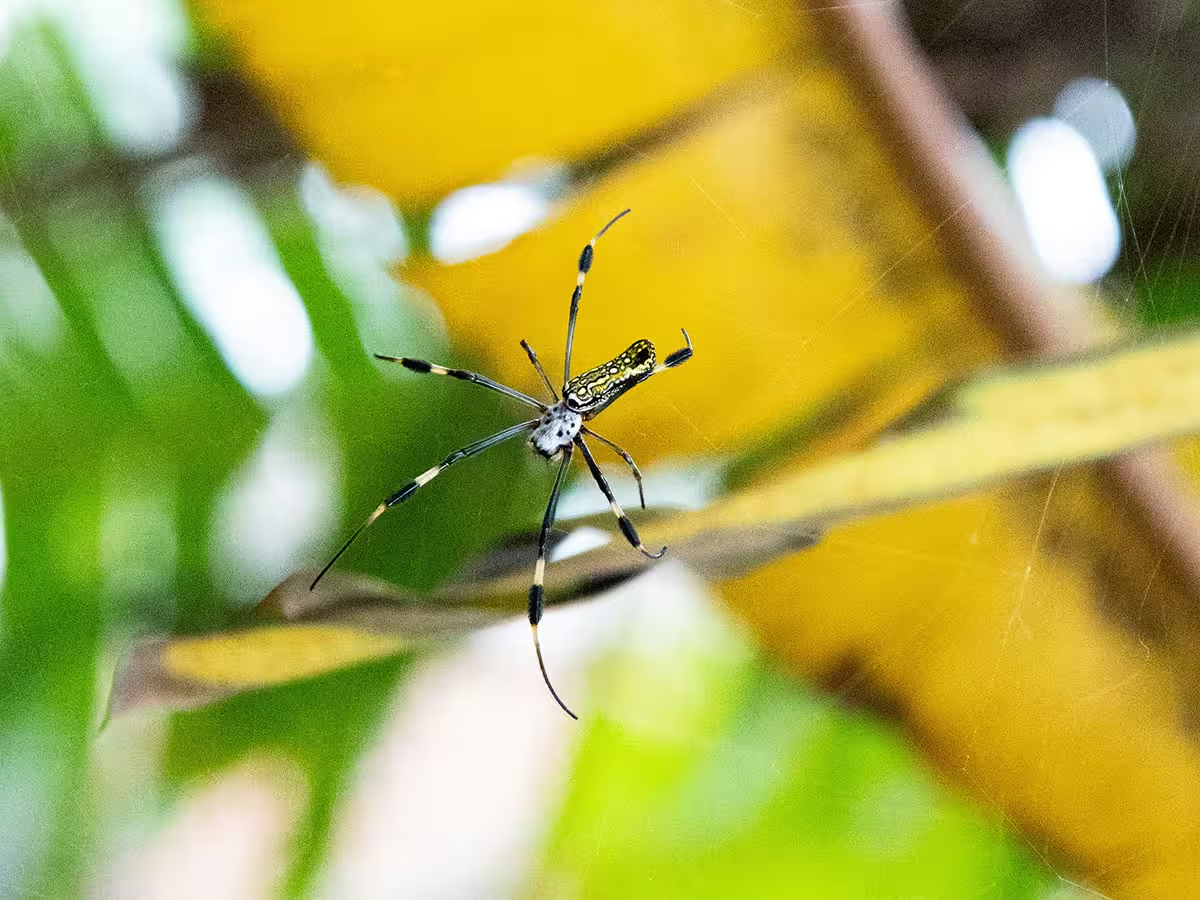
A close-up of the striking joro spider (trichonephila clavata), recognizable by its bright yellow and blue-gray colors, resting at the center of its large web in a suburban backyard. Photo: Irving Trejo
In recent years, a large and striking spider has started attracting attention in different parts of the United States. It is the Joro spider, a species native to East Asia that has gained notoriety because of its spread, its massive golden webs and its dramatic appearance. Although many headlines present it as a frightening menace, the reality is far more nuanced: its expansion worries researchers and environmental authorities, but its danger to people is considered low.
What spider is it and why is everyone talking about it
The species making headlines is the Joro spider, scientifically known as Trichonephila clavata. It is native to Japan and other parts of East Asia. In the United States, it was first documented in 2014, and since then it has increased its presence, especially in the southeastern states.
Its fame comes from three clear factors: 1- its visually large size, especially in females, 2- its huge yellowish golden webs, and 3- its ability to adapt to different environments. That combination has turned the Joro spider into one of the most talked about invasive species in recent years.
How it got to the United States
The most accepted explanation is that the Joro spider arrived accidentally from Asia through commercial shipments. Experts believe it likely traveled in shipping containers, nursery materials, packaging or imported goods. This kind of arrival is common among invasive species because global trade often moves insects, spiders and other organisms across continents without anyone noticing.
Once established in the United States, the spider found favorable conditions for expansion. In addition to indirect human transport, young Joro spiders can disperse through a behavior known as ballooning, using silk threads to drift with the wind and settle in new places.
Characteristics of the Joro spider
The Joro spider stands out for its exotic appearance. Females are much larger than males and show a colorful abdomen with yellow, black and bluish markings, as well as long banded legs. Males are significantly smaller and much less visible.
Size: adult females can look very large when seen with their legs extended, although much of that impression comes from their leg span.
Coloration: they usually display bright combinations of yellow, black and darker tones.
Web: they build large, strong and sticky golden webs.
Behavior: they are generally shy and prefer to remain in their web rather than attack.
These traits help explain why so many people react with alarm when they find one in a yard, wooded edge, garden or suburban area.
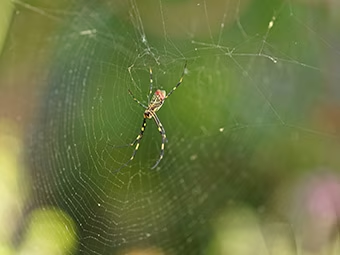
Myths and realities of the invasive giant spider
Photo: Kahar Erbol
Habitat and where it lives
The Joro spider adapts well to warm and humid places, although it has also shown an ability to tolerate changing conditions. Its habitat includes forest edges, gardens, suburban neighborhoods, crops, parks and any space with vegetation or structures that allow it to anchor its enormous webs.
In the United States, it has been reported especially in Georgia and other parts of the Southeast. It thrives in places with trees, shrubs, fences, posts and manmade structures where it can stretch its web from one support point to another. These webs can span several meters, which makes them highly visible and sometimes bothersome for people walking through green spaces.
Why it is considered an invasive species
An invasive species is one that arrives in an ecosystem where it is not native and may cause ecological, economic or health related harm. In the case of the Joro spider, the main concern is not attacks on humans, but its possible effect on ecological balance.
Researchers are studying whether it competes with native spiders for food and web building space. They are also looking into how it may alter local food webs by capturing a wide range of insects. However, there is still no final consensus on the full scale of its long term impact.
What it eats and what damage it may cause
The Joro spider feeds on insects trapped in its web. Its prey may include flies, moths, stink bugs, small wasps and other flying arthropods. Its strong ability to catch insects has opened an interesting debate: on one hand, it may consume nuisance insects or even some pest species; on the other, it may also affect native insects and alter established ecological interactions.
Ecological damage: it may compete with native spiders and change local insect predation dynamics.
Urban nuisance: its large webs may appear around entrances, gardens, porches, wires and pathways.
Economic impact: there is no evidence so far of massive economic damage like that caused by other invasive pests, but there is concern about future ecological effects.
In other words, the biggest issue is not that it is aggressive, but that it is a non native species with expansion potential and an ecological role that is still being studied.
Is it dangerous to people or pets
Despite its intimidating appearance, current evidence suggests that the Joro spider does not pose a major danger to humans. Its venom is meant to immobilize small prey, not to cause severe harm to people. Bites are rare because this is a timid spider that usually avoids direct contact.
When a bite does happen, the effects are generally mild, such as redness, local irritation or slight discomfort. As with many bites and stings, an allergic person could have a stronger reaction, but that is not considered the usual outcome.
For pets, the general risk is also viewed as low, although direct contact with any unfamiliar spider should always be avoided.
How to identify it quickly
To recognize a Joro spider, these visual details are useful:
1- a large and striking body in females
2- yellow and black patterns on the abdomen
3- long legs with visible bands or markings
4- a broad, strong web with a golden or yellowish tone
That combination makes it quite different from many common household spiders in North America.
What to do if it appears at home or in the yard
If a Joro spider appears on a property, panic is not the best response. In many cases, removing the web carefully and keeping some distance is enough. If the spider keeps reappearing, homeowners may contact local pest control services or agricultural extension offices for guidance.
Basic steps: wear gloves when clearing webs, inspect outdoor furniture, trim dense vegetation and reduce places where large webs can be anchored.
Handling the spider with bare hands is not advisable. Even though its danger is low, caution is always the better choice.
Why it creates so much fear online
The Joro spider went viral because it has everything that social media amplifies: size, bright colors, an exotic look and giant webs. That fuels dramatic headlines and exaggerated posts that make the species seem more dangerous than it really is. From a journalistic point of view, it is visually powerful. From a scientific point of view, it is an invasive species that still requires careful study before final judgments are made about its long term ecological role.
What is known today about its spread in the United States
Since its first documentation in 2014, the Joro spider has established itself in the southeastern United States and has continued expanding. Researchers, universities and agricultural agencies are tracking its distribution to better understand its adaptation, diet and possible influence on native species. Everything suggests that its spread is supported both by human movement and by its own natural dispersal ability.
For more information in English, readers can consult the University of Georgia Extension and the United States Department of Agriculture, which regularly publish educational material and research references related to invasive species and the Joro spider.
The Joro spider in the United States: eye catching, invasive and still under study
The spider invading the United States is not an apocalyptic creature or a deadly threat to the public. It is, rather, an invasive species with strong adaptive capacity, a highly recognizable appearance and an ecological impact that is still being investigated. Its presence deserves attention, especially for what it may mean for local ecosystems, but not because it represents a high risk to people. Understanding how it arrived, where it lives and what role it may play in nature is essential to separate fear from fact.


See Also







Discovery Chepe
Most read...