



Why does the Moon always show us the same face?
The far side of the Moon: Truths behind the mystery
Reading time: 1 minute, Discovery Chepe Id-839-TEC
Published on 04-07-2026
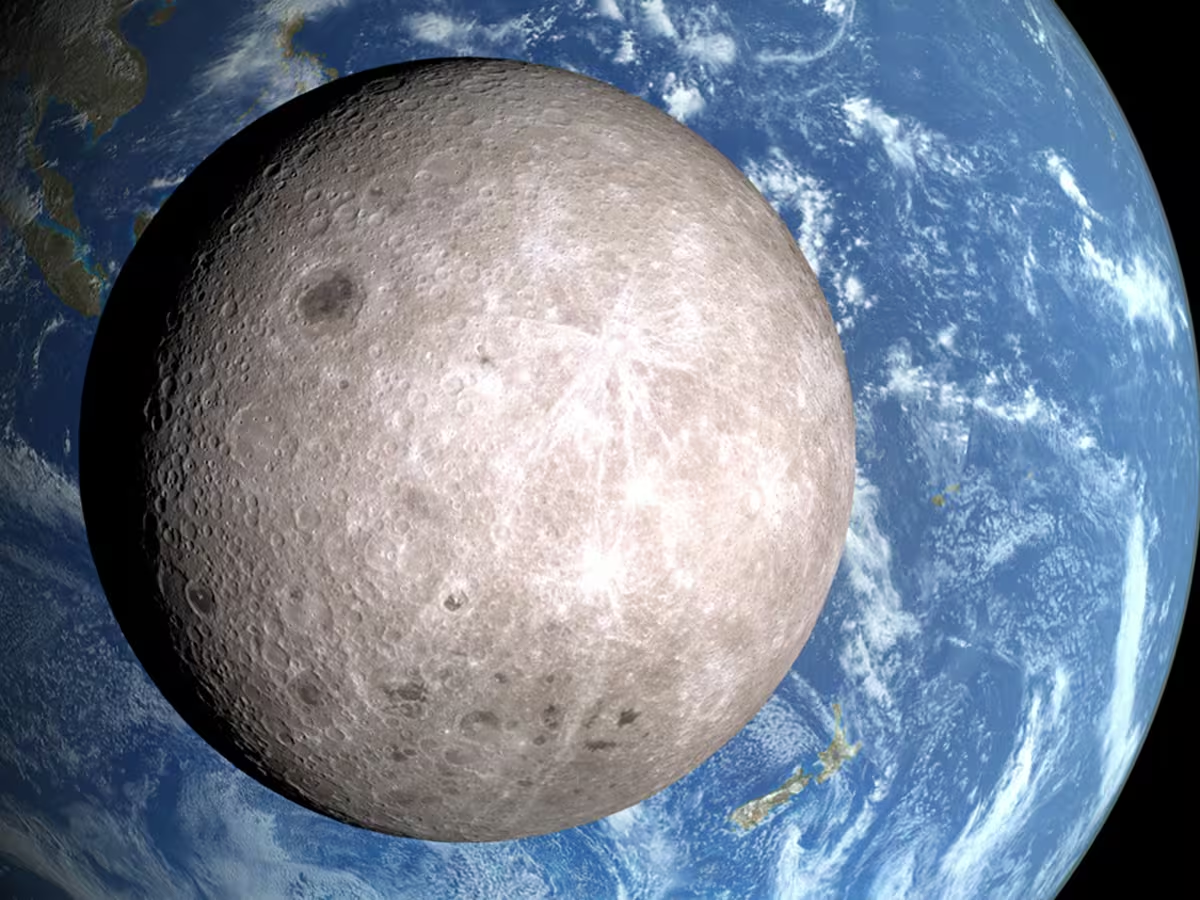
Detailed view of the lunar hemisphere that remains invisible from earth due to the phenomenon of tidal locking.Photo: NASA
For centuries, humanity has gazed at the night sky and observed the Moon as a constant companion. Yet there is a fascinating detail many people overlook: we always see the same side. Why does this happen? Does the Moon not rotate? The answer is more complex and intriguing than it seems.
Does the Moon rotate or stay still?
At first glance, it may appear that the Moon does not spin, but it actually does. The Moon rotates on its own axis just like Earth. The key is that its rotation is perfectly synchronized with its orbit around our planet. This phenomenon is known as tidal locking.
In simple terms, the Moon takes exactly the same amount of time to rotate once as it does to orbit Earth: about 27.3 days. As a result, it always shows the same face to us.
What is tidal locking?
Tidal locking is the result of millions of years of gravitational interaction between Earth and the Moon. It can be understood in three steps:
1- Earth's gravity created tidal forces on the Moon.
2- These forces caused internal friction that slowed its original rotation.
3- Eventually, its rotation matched its orbital period.
This balance ensures that one hemisphere constantly faces Earth while the other remains out of view.
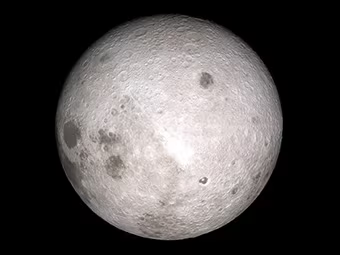
Everything you didn't know about the lunar far side
Photo: NASA
The so called 'dark side': a misleading term
Although often called the 'dark side', this region is not permanently dark. It receives sunlight just like the near side, but it is not visible from Earth. For this reason, scientists prefer the term far side.
The visible side is smoother and features large plains known as lunar maria, while the far side is more rugged and heavily cratered. This contrast has puzzled scientists for decades.
When did we first see the far side?
Humanity first observed the Moon's far side in 1959 when the Soviet spacecraft Luna 3 captured the first images, revealing a dramatically different landscape.
Since then, multiple missions have explored this region, including recent missions that successfully landed there despite the communication challenges.
Why is the far side so different?
Scientists have proposed several explanations:
a) The lunar crust is thicker on the far side, preventing large lava plains from forming.
b) Earth's gravity may have influenced internal heat distribution.
c) Massive impacts shaped the surface unevenly.
These ideas continue to be studied as we learn more about the Moon.
A fascinating cosmic balance
The Moon is not frozen in place but is part of a delicate gravitational balance that has lasted billions of years. Many moons in the solar system are also tidally locked to their planets.
To explore more, visit this explanation of tidal locking or check NASA's Moon exploration page.
Next time you look at the Moon, remember that one side will always remain hidden from Earth, a quiet reminder of the universe's intricate laws.
One of the highest quality images ever released of the moon pic.twitter.com/bvgp91hb8c
— Pubity (@pubity) April 7, 2026


See Also





Discovery Chepe
Most read...