



Patagonia Under Threat: The Impact of Argentina's New Glacier Law
Mining in Protected Zones? Analyzing the 2026 Legal Reform
Reading time: 1 minute, Discovery Chepe Id-846-ECO
Published on 04-16-2026

A panoramic view of the Patagonian Andes, where recent changes to the Glacier Law allow mining activities in sensitive ecosystems vital for regional water security. Photo: Christian Meyer-Hentschel.
Argentina's Patagonia region, globally recognized for its breathtaking landscapes, unique biodiversity, and vast glaciers, is facing a critical moment. The recent approval of a new regulation related to the Glacier Law has raised concerns among environmentalists, scientists, and local communities, who warn about the risks posed by mining projects in sensitive areas.
A fragile ecosystem under pressure
Patagonia's glaciers are not only an invaluable natural heritage but also strategic freshwater reserves. In the context of climate change, their preservation is essential to maintain ecological balance and ensure water supply for thousands of people.
However, the relaxation of regulations opens the door to mining exploration and exploitation near or even within glacier environments. Experts warn that this could cause irreversible impacts such as river contamination, soil disruption, and accelerated ice melting.
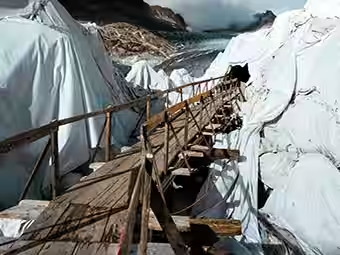
Argentine Glaciers: Environmental Risks of New Mining Projects
Photo: Patrick Robert Doyle.
Key aspects of the new legislation
To understand the scope of this controversial measure, it is important to highlight key points:
1- Expansion of exploitable areas: mining activities are now allowed in previously restricted zones.
2- Review of glacier inventories: updates may reduce protected areas.
3- Economic priority: economic development is prioritized over environmental conservation.
These changes have been justified by the Argentine government as a strategy to boost the economy and attract foreign investment. However, many sectors question the environmental cost of these decisions.
Voices from science and society
Environmental organizations like Greenpeace have expressed strong opposition, warning that the measure threatens one of the planet's most important ecosystems. Learn more at Greenpeace Argentina.
Scientists from the National Scientific and Technical Research Council have emphasized that any intervention in glacier areas must be handled with extreme caution, as impacts can be cumulative and difficult to reverse.
Social and economic impact
Mining promises jobs and development, especially in regions with limited economic opportunities. However, local communities fear that benefits will be temporary while environmental damage could last for generations.
Additionally, sectors such as tourism, which rely heavily on Patagonia's natural landscapes, could be severely affected. Patagonia is a key destination for ecotourism, and environmental degradation could lead to significant economic losses.
A difficult balance to achieve
The debate over the new Glacier Law reflects a global dilemma: how to balance economic development with environmental protection. In Patagonia's case, the decision affects not only Argentina but an ecosystem of international relevance.
Attention is now focused on how the law will be implemented and whether authorities can ensure effective oversight. Meanwhile, Patagonia remains a symbol of natural beauty facing one of the most significant threats in its recent history.


See Also






Discovery Chepe
Most read...