



Terafab: Everything About Elon Musk's New Chip Giant
What is Terafab? Musk's Bold Move into AI Semiconductors
Reading time: 1 minute, Discovery Chepe Id-833-TEC
Published on 03-25-2026
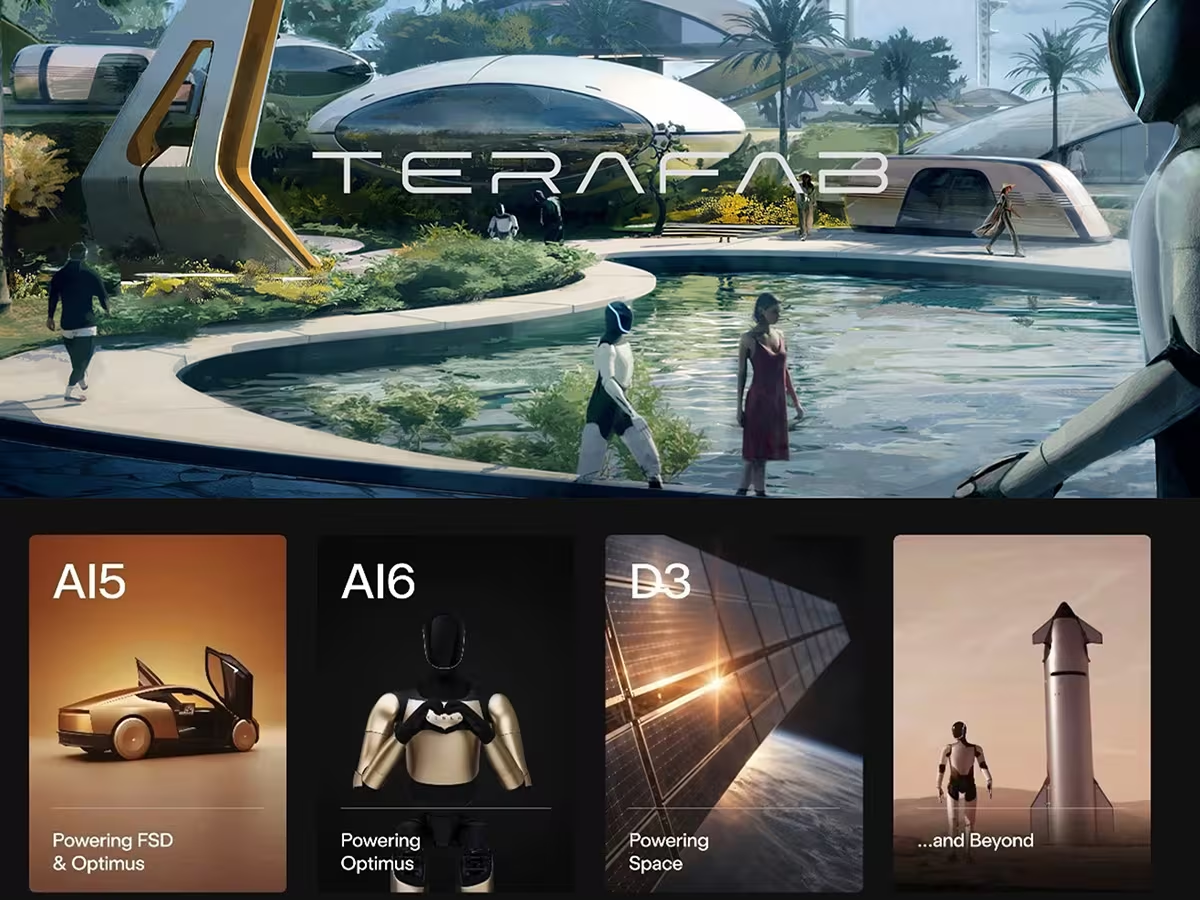
Terafab complex in Austin, Texas, where Elon Musk aims to centralize global production of artificial intelligence chips. Photo: terafab.ai
In a global landscape shaped by automation, artificial intelligence and energy transition, the name of Elon Musk once again draws attention with a new initiative: Terafab. This emerging company aims to become a key player in transforming large-scale manufacturing by combining technological innovation with industrial efficiency.
What is Terafab and why is it generating so much attention?
Terafab represents an evolution of Musk's business philosophy: building disruptive yet scalable solutions. The term 'Tera' suggests massive scale, while 'fab' refers to fabrication. Together, they point toward factories capable of unprecedented production levels.
Its potential applications span multiple industries, including batteries, advanced materials and electronics. While details remain limited, Terafab could become a cornerstone of future global supply chains.
Origin of the idea: from Gigafactories to hyperautomation
Terafab builds upon lessons learned from large-scale industrial projects. It aims to overcome existing limitations through:
1- Scalability: Expanding production beyond current limits.
2- Full automation: Minimizing human intervention.
3- Energy efficiency: Reducing energy consumption per unit.
4- Flexibility: Rapid adaptation to new products.
The concept revolves around intelligent factories driven by advanced algorithms.
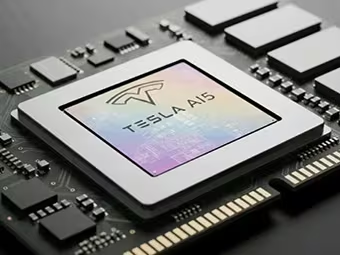
Terafab Austin: The New Hub for Global Artificial Intelligence
Photo: terafab.ai
Strategic objectives
a) Sustainable mass production: Integration of renewable energy.
b) Cost reduction: Making advanced technologies more accessible.
c) Continuous innovation: AI-driven improvements.
d) Industrial independence: Stronger supply chains.
Technology and processes
Terafab's model relies on:
Robotics: Precision manufacturing.
Predictive AI: Real-time optimization.
Full digitalization: Connected production systems.
Modular design: Flexible manufacturing lines.
Purpose and global impact
Terafab aims to address major challenges such as clean energy production, technological demand and global competitiveness.
Its impact could reshape industries, though challenges such as job displacement and regulation will arise.
For more insights, visit:
https://www.weforum.org
Terafab reflects a bold vision of the next industrial revolution.
Elon Musk Unveils Insane New Project (Terafab)
— Farzad 🇺🇸 🇮🇷 (@farzyness) March 22, 2026
This edit improves audio and is edited down to save time. pic.twitter.com/Yi2E8Zqrmt


See Also







Discovery Chepe
Most read...