



The walking palm: myth or biological reality?
Socratea exorrhiza: the mystery of the moving tree
Reading time: 1 minute, Discovery Chepe Id-829-ECO
Published on 03-21-2026
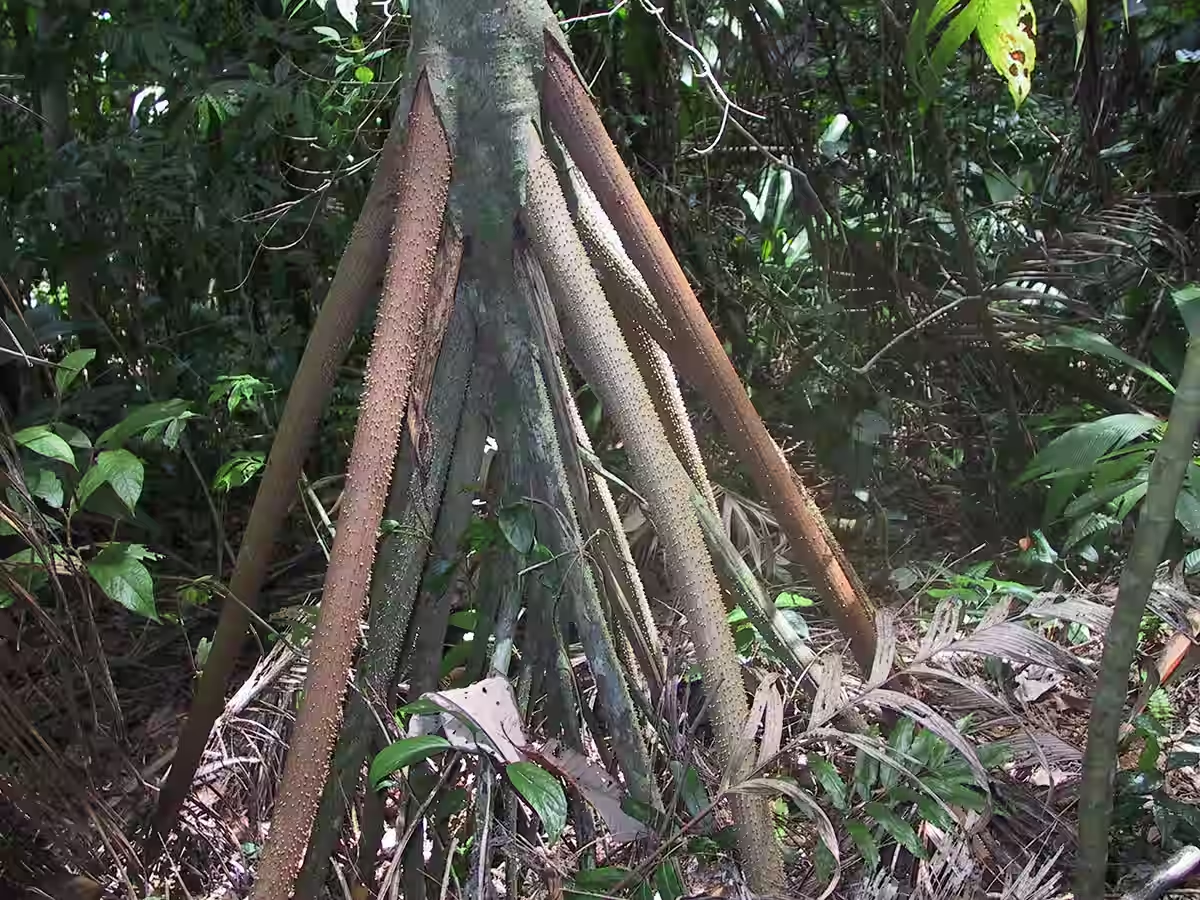
Exposed roots of the walking palm (Socratea exorrhiza). This fascinating root system allows it to move slowly through the understory in search of openings with more light. Photo: Wikipedia
Deep in the humid rainforests of Latin America grows a plant that has fascinated scientists, travelers and nature lovers for decades: Socratea exorrhiza, widely known as the walking palm. Its reputation comes from an almost unbelievable idea, that a tree can slowly move across the forest floor. While its unusual shape has fueled that story, science offers a more careful explanation. What is certain is that this tropical palm is a remarkable species with stilt roots, strong adaptive traits and an important ecological role in rainforest environments.
What is Socratea exorrhiza
Socratea exorrhiza is a palm species in the Arecaceae family, native to the tropical forests of Central and South America. It grows in countries such as Costa Rica, Panama, Colombia, Ecuador, Peru, Brazil, Venezuela, Guyana, Suriname and French Guiana. It usually reaches between 15 and 25 meters in height, with a slender upright trunk topped by long feather-like leaves that give it a graceful and distinctive appearance.
Biological facts about the walking palm
1- Family: Arecaceae.
2- Scientific name: Socratea exorrhiza.
3- Plant type: Solitary-stem tropical palm.
4- Height: Commonly 15 to 20 meters, sometimes up to 25 meters.
5- Trunk: Thin, straight and relatively narrow for its height.
6- Roots: It has stilt roots that raise the trunk above the ground and form a cone-like base.
7- Leaves: Large pinnate leaves clustered at the top of the trunk.
8- Reproduction: It is monoecious, meaning male and female flowers are borne on the same plant.
9- Pollination: Research indicates that beetles play a role in pollination.
10- Fruits: It produces fleshy fruits that feed wildlife and contribute to seed dispersal.
Natural habitat
This palm grows in humid tropical forests, including lowland rainforest and some montane areas. It thrives in environments with high moisture, filtered light and variable soils. It is often found in dense forests, near watercourses and in places where competition for sunlight is intense. Its habitat is linked to highly biodiverse ecosystems, where it interacts with birds, mammals, insects and many epiphytic plants.
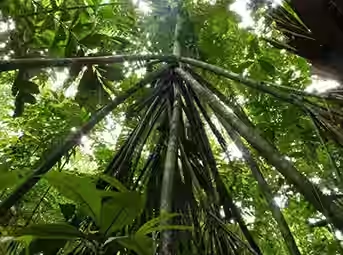
Botanical wonders: the tree with walking roots
Photo: Flowersmanmx
The feature that made it famous
The most striking trait of Socratea exorrhiza is its aerial stilt roots. At first glance, they look like thin supports lifting the trunk above the forest floor. This gives the palm an unusual appearance, almost as if it were standing on multiple legs. That visual effect is exactly what inspired the popular name walking palm.
How does it 'walk'
This is where the legend begins. A popular claim says the palm can slowly shift its position by growing new roots toward a better light source while older roots on the opposite side die off. In simple terms, the story suggests that the plant gradually changes its place in the forest by rearranging its base over time.
What science says about that movement
Scientific evidence does not strongly support the idea that the palm truly walks as a regular behavior. What researchers have observed is that its stilt roots may help the plant stay stable, cope with disturbance and regain an upright position if a young palm is tilted by falling branches, debris or uneven ground.
So, rather than walking across the rainforest like an animal, Socratea exorrhiza seems to adjust its support system. That process can create the impression of movement, but it is not the same as real locomotion. Many botanists believe the main functions of these roots are mechanical support, structural stability and successful growth in areas filled with organic obstacles.
Why its roots matter so much
a) Stability: They help the palm remain upright on irregular or debris-covered ground.
b) Adaptation: They allow the plant to respond to environmental disturbance.
c) Structural advantage: They distribute weight efficiently and support the tall trunk.
d) Rainforest survival: They improve establishment in difficult forest conditions.
Its relationship with wildlife and the ecosystem
The fruits of this palm are eaten by different animals, and its seeds interact with mammals and other forest species. Its trunk and structure can also host epiphytes, turning the palm into a support system for other forms of life. That means it stands out not only for its strange appearance, but also for its ecological importance.
A legend rooted in reality, but overstated
The walking palm is not pure fiction, yet it is not a tree that takes real steps through the jungle either. The truth is more subtle and, in many ways, more fascinating. It is a plant with exceptional architecture, able to adjust its support, endure disturbance and thrive in one of the most complex ecosystems on Earth. Its supposed movement is better understood as a mix of growth, adaptation and structural response rather than true walking.
Why it still captures so much attention
Because it brings together three irresistible elements: unusual beauty, biological mystery and a story that lives somewhere between science and popular imagination. In a world constantly searching for natural wonders, Socratea exorrhiza remains one of the rainforest's most intriguing species. Even if it does not truly walk, the way it survives is extraordinary enough.
More information in English
You can read more at Wikipedia in English on Socratea exorrhiza and explore broader botanical resources at Kew Gardens.


See Also




Discovery Chepe
Most read...